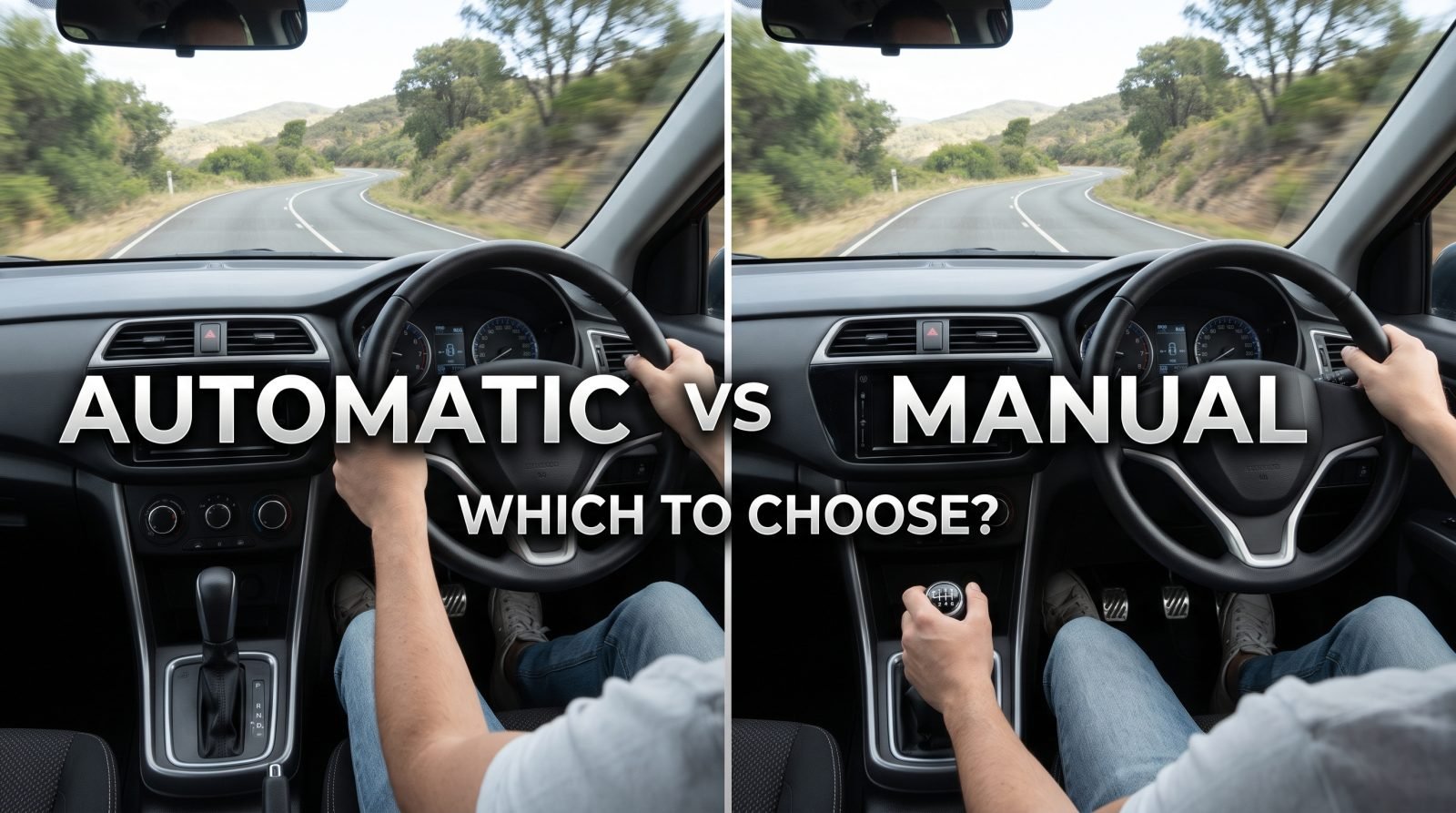
Choosing between automatic and manual is the first big decision when you start learning to drive. It affects how long it takes to pass, how much your lessons cost overall, and which cars you can drive afterwards. This guide sets out the real differences, honestly, so you can pick the right one for you, and shows where we run automatic intensive courses across South and West Wales.
The short answer
If you want to pass as quickly as possible, are nervous about clutch control, or will mostly drive newer, hybrid or electric cars, automatic is usually the better choice. If you need to drive a manual car for work, family or holidays abroad, learning manual keeps every option open.
Automatic vs manual: the key differences at a glance
| Automatic | Manual | |
|---|---|---|
| Gears and clutch | None to manage: just accelerator and brake | Clutch pedal and gear stick to coordinate |
| Stalling | Practically impossible | Common while learning, especially at junctions |
| Hill starts | Simple: most cars hold on a hill | Needs clutch control and the handbrake |
| Time to test standard | Usually fewer hours | Usually more hours |
| The driving test | Same test, same standard | Same test, same standard |
| Licence you get | Automatic cars only | Manual and automatic cars |
| Electric and hybrid cars | Covered: they are all automatic | Covered |
Why automatic is easier to learn
In a manual car, a big part of your attention goes on the car itself: finding the biting point, choosing the right gear, and not stalling at a busy roundabout. In an automatic, the car does all of that for you, so almost all of your attention goes on the road: observation, planning ahead, positioning, junctions and hazards. Those are the skills the examiner is actually marking.
That is why most learners reach test standard in noticeably fewer hours in an automatic. Fewer hours usually means a lower total cost, even where an automatic lesson costs a little more per hour, and it is the main reason an automatic intensive course can get you from your first lesson to your test in days rather than months.
Better for nervous learners
If stalling in traffic or rolling back on a hill worries you, removing the clutch takes away the most stressful part of learning. Lots of learners switch to automatic after struggling in a manual, and find they progress far faster once they can concentrate on the road.
Why more learners are choosing automatic
Automatic is no longer the unusual choice. According to the AA’s analysis of DVSA figures, automatic tests made up almost three in ten car driving tests in 2025/26, up from around one in 25 in 2007/08.
The cars on the road are changing
Every fully electric car is automatic, and so are almost all hybrids. Sales of new petrol and diesel-only cars are due to end in the UK in 2030, with full and plug-in hybrids allowed until 2035, after which new cars must be zero emission. The cars you are likely to buy, lease or drive for work in the years ahead are increasingly automatic, so a manual licence matters less than it used to.
What an automatic licence lets you drive
If you pass your test in an automatic, your licence covers automatic cars only, including every electric car. You cannot drive a manual car on it.
If you later decide you want to drive a manual, you can upgrade by passing a practical driving test in a manual car. According to GOV.UK, you do not need to take the theory test again to upgrade, and you can keep driving automatic cars even if you fail the manual test.
When manual still makes sense
- You need to drive a specific manual car, such as a family car you will share, or a van or vehicle for work.
- You hire cars abroad often. In much of Europe, the cheapest hire cars are still manual, and automatics can cost more to hire.
- You want the cheapest possible first car. Older used cars are more often manual, although that gap is closing every year.
If none of those apply to you, automatic is usually the quicker, calmer route to a full licence.
How many hours will you need in an automatic?
Every learner is different, but this is a reliable starting point. We will always confirm it with you before you book, and we would rather tell you honestly than sell you hours you do not need.
| Your experience | Suggested course | Typical length |
|---|---|---|
| Complete beginner | 40–45 hours | 8–9 days |
| A few lessons, some private practice | 30–35 hours | 6–7 days |
| Part trained, driving independently | 20–25 hours | 4–5 days |
| Nearly test standard | 10–15 hours | 2–3 days |
| Failed a test, a few faults to fix | 5–10 hours | 1–2 days |
Hours can run on consecutive days for the quickest possible pass, or be spread across a couple of weeks to fit around work or college. See every course and price on our automatic course prices page.
Automatic intensive and crash courses across South and West Wales
We teach automatic only, one-to-one, in dual-controlled cars, with test preparation on the roads around your local test centre. Choose your area for local information and prices:
Vale of Glamorgan · Barry test centre Automatic courses in Bridgend
Bridgend County · Bridgend test centre Automatic courses in Cardiff
Cardiff · Llanishen test centre Automatic courses in Carmarthen
Carmarthenshire · Carmarthen test centre Automatic courses in Llanelli
Carmarthenshire · Llanelli test centre Automatic courses in Llantrisant
Rhondda Cynon Taf · Llantrisant test centre Automatic courses in Merthyr Tydfil
Merthyr Tydfil · Merthyr Tydfil test centre Automatic courses in Pontypridd
Rhondda Cynon Taf · Llantrisant or Merthyr test centre Automatic courses in Porthcawl
Bridgend County · Bridgend test centre Automatic courses in the Rhondda Valleys
Rhondda Cynon Taf · Llantrisant or Merthyr test centre Automatic courses in Swansea
Swansea · Swansea test centre
Not on the list? We cover the towns and villages around each of these areas too. Get in touch and we will check for you.
Automatic vs manual: frequently asked questions
Is it easier to pass in an automatic?
Learning is easier because there is no clutch or gears to manage, so most people reach test standard in fewer hours. The test itself is exactly the same and is marked to the same standard, so you still need to be a safe, confident driver to pass.
Can I drive a manual car with an automatic licence?
No. An automatic licence only covers automatic cars, including electric cars. You can upgrade later by passing a practical test in a manual car, without taking the theory test again.
Is the automatic driving test different from the manual test?
No. It is the same test: the eyesight check, “show me, tell me” questions, general driving, independent driving and a manoeuvre. The only difference is the car.
Do I still need to pass the theory test?
Yes. Everyone needs to pass the theory test before taking the practical test, whichever type of car you learn in. Our theory test guide shows you how to prepare quickly.
What is an automatic crash course?
It is another name for an intensive course: your lessons are packed into a few days or a couple of weeks instead of an hour a week, finishing with your practical test. Crash course, fast track course and intensive course all mean the same thing.
How quickly can I pass in an automatic?
It depends on your experience and your test date. Drivers who are nearly test standard can be ready in two or three days; complete beginners usually need around eight or nine days of driving. Tell us your test date and we will plan your course to finish just before it.
Still deciding? Call us and we will talk through your experience and recommend the right course, or send us your details and we will get back to you.
Ready to get your automatic licence?
One-to-one automatic intensive and crash courses across South and West Wales, from 5 to 45 hours. Tell us about your driving and we will recommend the right course.